


Visiting SAIAB in South-Africa for the PUFFINS project
Updated: Aug 25
As part of our ongoing collaboration on the PUFFINS project (which has nothing to do with puffins) with colleagues in South Africa, Lars Martin recently spent 2 weeks combining lab visits, fieldwork, and the funding programme's conference. Here’s a short update from the trip.

My first day was dedicated to a visit to the South African Institute for Aquatic Biodiversity (SAIAB). I was given a full tour of the facilities, including their laboratories and library, offering a great introduction to the research taking place there. The highlight, however, was without question SAIAB’s remarkable fish collection—the largest in the Southern Hemisphere. Walking through the collection, with more than 1.3 million preserved specimens, was both inspiring and humbling. It is an incredible resource for biodiversity research and a reminder of how much has already been documented—and how much there is still left to understand. The collection is currently working on a digital library with pictures, genomes, and more.

On day two, we headed out early to the Sundays Estuary with the goal of catching spotted grunters for ecotoxicological sampling. Before any fishing could begin, we had to collect bait—by pumping prawns out of the sand. This turned out to be a field exercise in itself, requiring patience and persistence. Once we had gathered enough bait, we finally got started with the fishing. Despite our efforts, the catch was modest. We managed to land just a single, small spotted grunter (proudly documented in a photo), while the rest of us had less success. One of us did, however, achieve a personal record—albeit for the smallest stubnose ever caught! Some days in the field remind you that nature sets the rules.
Not every field day goes according to plan, and day three was, frankly, a reminder of that. Sometimes conditions, luck, and timing just don’t align. Even though we got exciting bycatch such as a dusky kob and Torpedo ray, our luck with spotted grunters were poor. However, Taryn took home a new personal size-record with the single spotted grunter we caught, with a total length of 64cm.
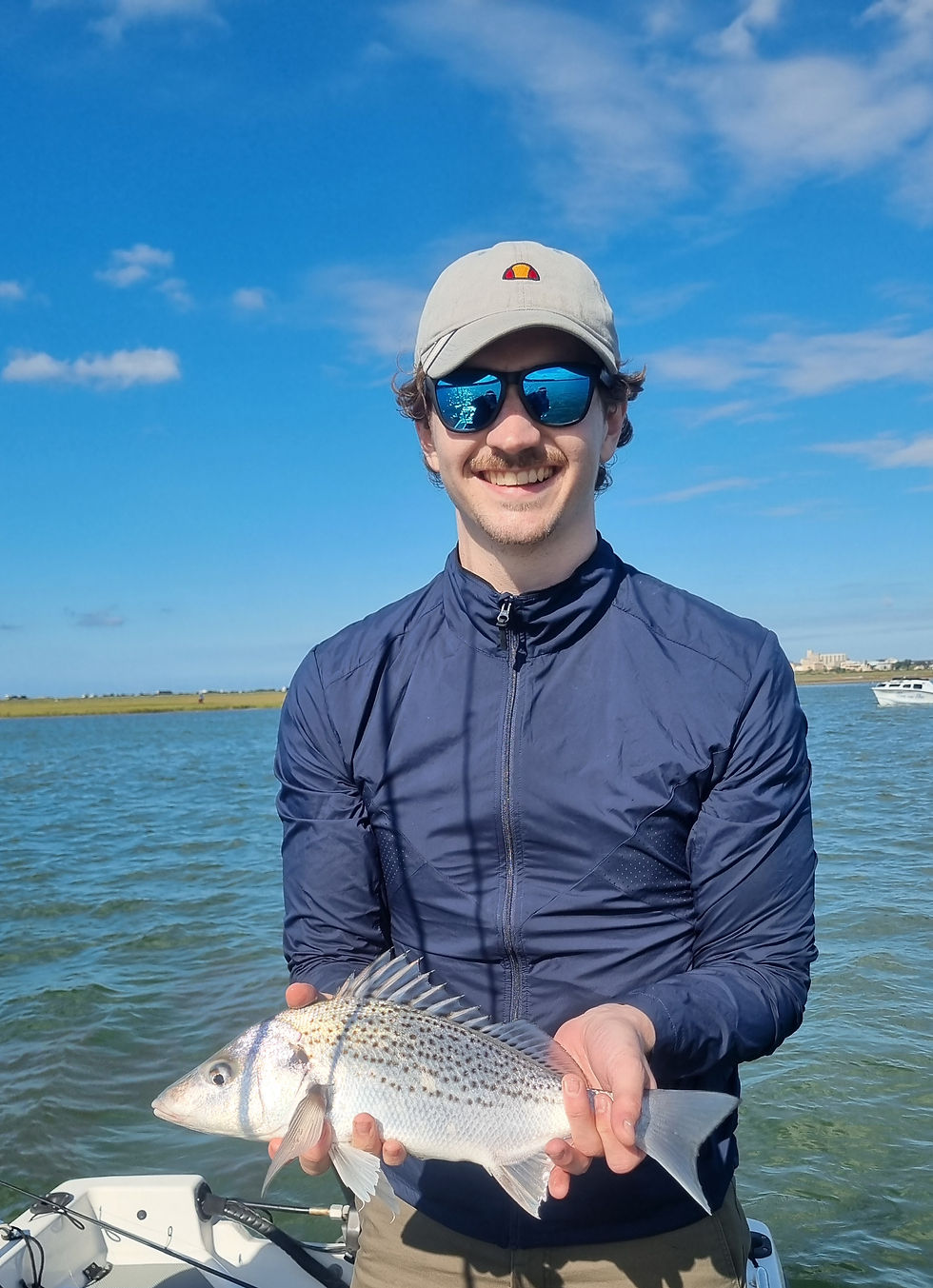
Day four brought a welcome turnaround. Back in field at the Swartkops Estuary, we were determined to improve on the previous days’ results. We started, as always, with prawn pumping—but this time with a more strategic focus. Based on local knowledge, we targeted sand prawns instead of mud prawns, as the word was that fish had been biting better on them the day before. The difference between the two types of bait was clearly visible. This change paid off. The fish were finally biting, and one team member in particular made a strong contribution, catching four of the six spotted grunters landed that day (with one released again). With that, we had collected all the fish we needed.

The remainder of the day was dedicated to processing samples. From each fish, we carefully extracted liver, stomach, gills, muscle tissue, and otoliths. It was meticulous work, requiring coordination and focus. A special thanks goes to Taryn, who somehow managed to keep track of notes from four people working simultaneously—a true feat in itself.
The following week, Taryn and I attended the two day conference (the main event of my exchange). The conference focused on theory of change and how to improve research collaborations between Norway and South Africa. The highlight of the conference was dinner at the ambassadors house, which I was too embarrassed to take pictures of.

All in all I want to thank SAIAB and especially Taryn for being great hosts. We look forward to returning the favor when they come to visit us later in the project period.
This work was funded by the Norwegian Research Council through the PUFFINS project (project no. 352869).


Comments