


Tracking Trout in Bergen City

In late November, our team returned to one of Bergen’s urban bay Store Lungegårdsvann to learn more about the sea trout that move between the fjord and the small river Møllendalselva. While these fish are iconic in Norwegian culture and ecology, the ones living in this busy part of the city still hold many mysteries.
Sea trout is the migratory form of brown trout. After spending their early years in freshwater, they move out to the fjords to feed before returning to spawn. They’re remarkably adaptable: changing behaviour and habitat use depending on the river, the population, and even individual personality.
In Store Lungegårdsvann, right in the city centre of Bergen, sea trout feed along the tidal shallows. A smaller number also make their way into Møllendalselva, a narrow urban stream shaped by decades of construction and industrial activity. Today, the surrounding area is planned redesigned and restored to become a greener, more natural space. Understanding how trout already use this area will help us track how they respond as the river area improves.

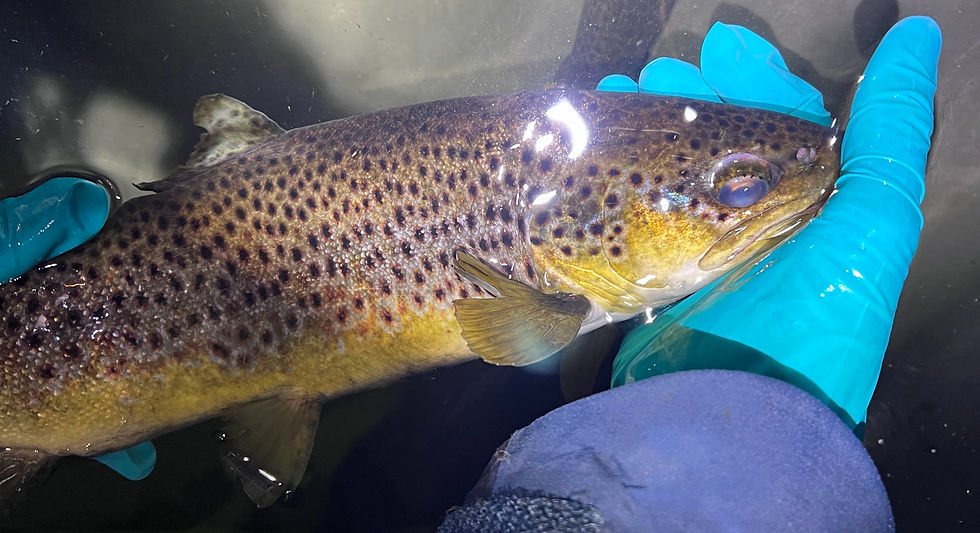
Catching sea trout in Store Lungegårdsvannet has never been easy. Despite many attempts with rod and line in 2024 and 2025, we had little luck. We only successfully tagged one sea trout in 2024, but for 2025 we knew we needed a different strategy. So we returned to a method that worked well for us back in 2021, with a twist. This year, instead of electrofishing, we searched for trout at night using headlamps. In the quiet hours after dark, we gently scooped them up using hand nets. It’s simple, quiet, harmless, and surprisingly effective.
And it worked - we tagged five sea trout! Each fish was tagged with an acoustic tag equipped with a depth sensor, capable of transmitting data for over a year. These tags allow us to track where the fish go and how they move through the seasons. Our tagging work in 2024 already showed that trout in Store Lungegårdsvann make good use of the basin. This individual spent most of its time around the floating docks near Neptun but also ventured widely across the waterbody, especially in September and October.
With five more tagged trout now swimming freely in Store Lungegårdsvannet and Møllendalselva, we’re excited to see what their movements reveal. Do they prefer similar areas? And how might upcoming habitat restoration around Møllendalselva change their patterns? The data we collect over the next year will help us understand how adaptable sea trout really are in heavily modified environments, and how we can make urban waterways better for fish and people alike.
This work was supported by the Vestland Regional Research Fund (RFF project nr. 341381) and by the Norwegian Research Council (NFR project nr. 2749098).


Comments