


Pre-taste of winter: tagging cod with UNIS-students
For the fourth year in a row, we have collaborated with UNIS and the Arctic Population Ecology course in Svalbard. In early October, Knut held lectures at Svalbard about fish and fisheries ecology in the Arctic, with a primary focus on gadoids and salmonids and how climate change affects their habitat use, distribution, and ecology. He presented how telemetry can be used to study fish migration and movement, habitat use and behaviour, and thus contribute to increased understanding of how Arctic fish species respond to a changing climate.

The following week, Saron and Lars Martin joined forces and travelled to Svalbard with the goal of the week to give students insight into acoustic telemetry and gut content analysis, while also applying this to a real ongoing research project.
The week started with a day of lectures and a practical introduction to both laboratory and field work. Saron and Lars Martin presented BTNs projects and showed examples of how acoustic telemetry is applied in our research. Later, the students were encouraged to reflect on animal welfare, ethics, and the scientific limitations and considerations associated with telemetry. This sparked several engaging discussions.

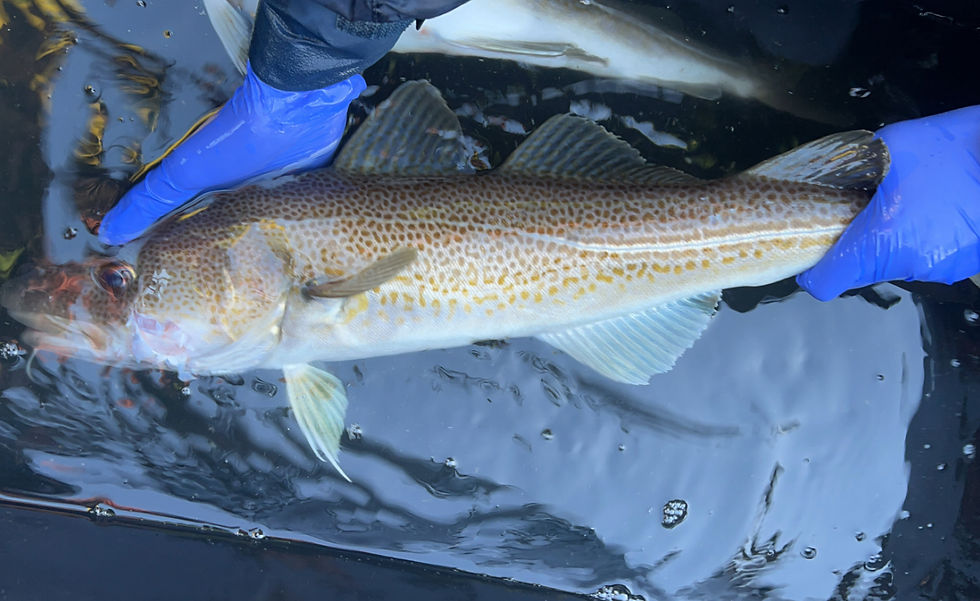
For the remainder of the week, the students were divided into two groups that alternated activities each day. One group joined the research vessel Hanna Resvoll in the fjord, while the other stayed onshore to conduct gut content analyses. On the water, the UNIS students provided invaluable help, spending hours angling for cod and haddock whilst also helping out during the tagging procedure. The weather was not on our side during the first two days, limiting our efforts to Adventfjorden. However, as the winds eased later in the week, we were also able to sample in Sassenfjorden and Borebukta. In total, we tagged 34 cod and one haddock.

The work on land was led by UNIS's own Monica. Over the course of the week, the students analyzed more than 75 gut samples. These results will be used towards our ROPES-project and tell us more about the diet of Atlantic cod and haddock in the fjords of Svalbard. Combined with tracking data, these results will help paint a more complete picture of how Arctic fjord ecosystems function today and how they may respond to future environmental change.
We want to thank UNIS for lending us their students and hope they found as much value from this week as we did! <3

This work was funded by the Norwegian Research Council through the NICE (NFR 134561) and ROPES (NFR 358617) projects.



Comments