


Tagging Cod at Herdla for the CARE-COD Project

Late January brought calm, cold, and dry winter days that gave us excellent opportunities to tag cod for the CARE‑COD project. The project aims to identify behavior and life-history of different Atlantic cod ecotypes and to investigate whether some ecotypes are more prone to rapid human‑induced changes. In previous CARE‑COD work, our catch efforts have focused further inside the fjords and therefore targeted coastal ecotypes. To improve our chances of catching other ecotypes, we moved our efforts in late January to Herdla, at the border between Herdlefjorden and Hjeltefjorden.
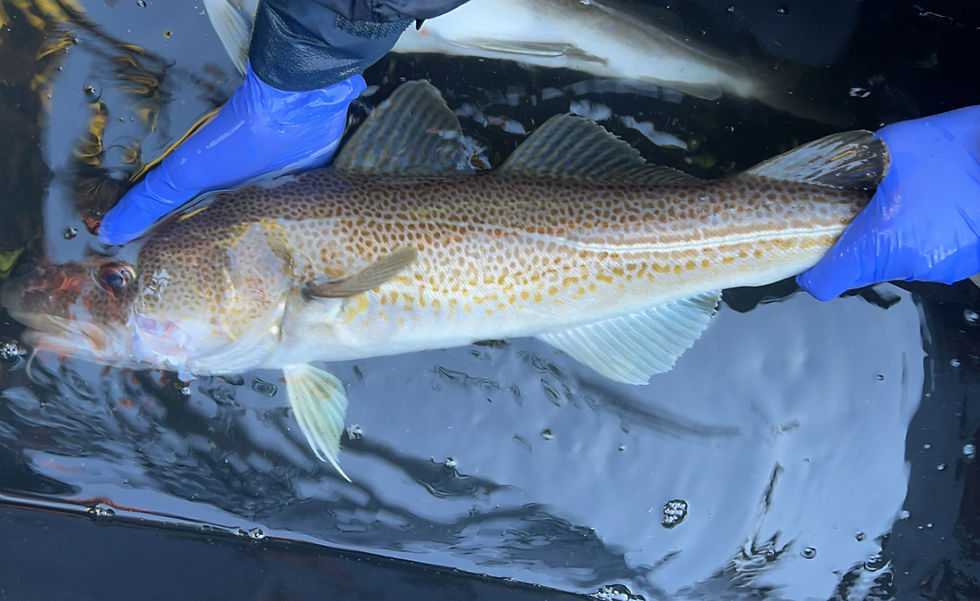
With help from local fishers, we were able to catch and tag 19 cod in the area, mostly using fyke nets. All 19 fish appeared healthy, showing good overall body-condition and with generally fewer parasites on their skin than we typically observe in other areas around Bergen. The efforts at Herdla even resulted in a new record for BTN, as one of the fishers caught a cod weighing more than 10 kilos, the biggest cod tagged by BTN to date.

At first glance, we only caught coastal ecotypes at Herdla as well. New efforts in more sea‑exposed areas in March will hopefully increase our chances of catching offshore ecotypes. Regardless, our efforts in January were still rewarding, as we collected tissue samples from all fish. These samples will undergo genetic analysis and shed light on questions related to gene flow. Because Herdla is closer to the North Sea, we will also investigate whether cod in this area are more exposed to “inter‑ecotypical breeding” than cod further inside the fjords.
We have also extended our receiver array by deploying more receivers in and around the capture and tagging locations at Herdla, and we are excited to see how these cod behave and move, as well as comparing these individuals’ movements with cod captured and tagged further in in the study system.

Thanks to the Norwegian Research Council for funding this work through the CARE-COD project (Project nr. 358185).



Comments