


Establishing Acoustic Monitoring in Finsevatn – First Step Toward an Alpine Freshwater Laboratory
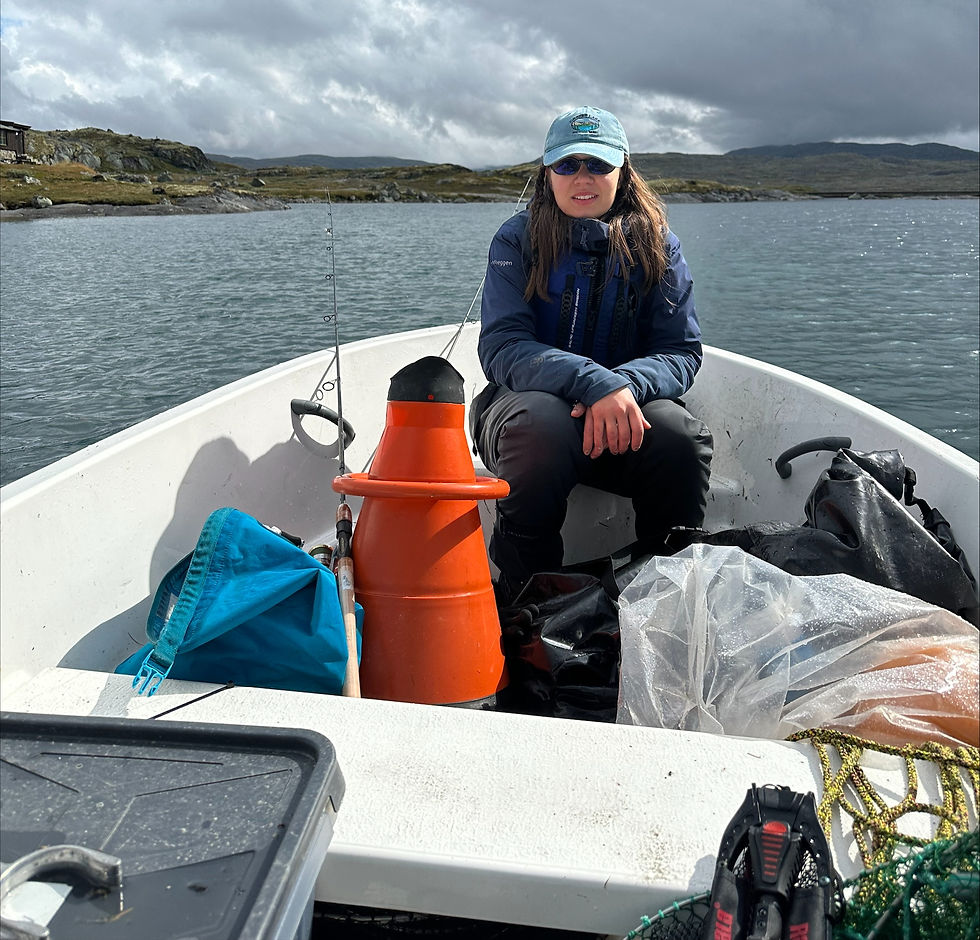
At the end of August, we spent three intense and exciting days at Finse, carrying out the first phase of the COLD pilot project to establish an Alpine Lake Telemetry Network. With mountains, glaciers, and lake Finse as the backdrop, we deployed the first listening stations in the lake and tagged Arctic charr with acoustic transmitters equipped with temperature and depth sensors. This marks an important step toward building an international research platform that will provide new knowledge on how climate change affects the ecology of alpine freshwater systems.

Lake Finse is a unique ecosystem, accessible via the Bergen Railway, characterized by an alpine climate and glacial meltwater inflow. The lake is home to both Arctic charr and brown trout—species highly sensitive to temperature changes. This makes the area an ideal site for studying how fish adapt—or lose ground—in the face of a warming climate.
By equipping the lake with a network of acoustic listening stations, we can track fish movements year-round, as well as the depths and temperatures they use.

The pilot phase began with the installation of listening stations i lake Finse. These underwater units register signals from acoustic transmitters surgically implanted in the fish. At the same time, we captured Arctic charr, which were carefully tagged with transmitters that record the fish’s position, depth, and the temperature conditions they experience.
Despite shifting mountain weather, we established a functioning system that is already collecting the first data on Arctic charr in lake Finse. These data will provide valuable insights into how the fish move within the lake and how they use different habitats.
This is only the beginning. The goal is to expand the system into a long-term network of listening stations linked to an open international database. In this way, Finsevatn can serve as a “natural laboratory” for studying how climate change affects fish populations and freshwater ecology in alpine lakes.
The project has significance far beyond Finse. By comparing with studies in Greenland and Svalbard, we will be able to connect alpine and Arctic systems and contribute to understanding how cold-water species respond to climate change.

In September, national and international partners will gather for a workshop at Finse to share experiences, develop common research questions, and plan the next phase. In the long term, the ambition is to establish Finsevatn as an international reference site for climate-related studies in freshwater systems.


Comments